
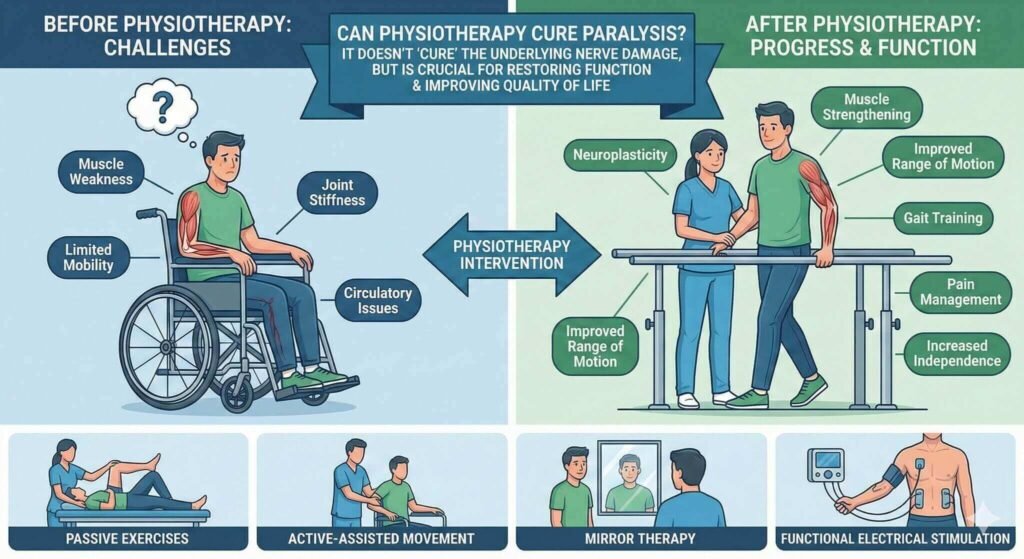
While physiotherapy cannot fully cure paralysis, it significantly helps patients restore movement, rebuild strength, and regain independence especially when started early after a stroke or injury. At Dr. Sahil’s Advanced Physiotherapy Clinic in Thane, we have helped hundreds of paralysis patients achieve meaningful recovery through targeted neuro-rehabilitation.
Physiotherapy is a silver lining for lost dreams due to paralysis. Paralysis is a medical condition that restricts body movement due to loss of muscles. People suffering from paralysis do not only lose sensation in the affected body area but also become incapable of effective movement like walking, running and sitting properly. With this condition, patients rely mainly on physiotherapy for quick recovery. With this being said, physiotherapy for paralysis patients in Thane is a medical program that has helped thousands of people to recover.
But one thing that patients should always keep in mind is that the results are highly unpredictable and dependent on the paralysis attack severity. To get in physiotherapy, one should be medically stable for physical exercise.
Symptoms of Paralysis Attack :
● Loss of muscle control
● Muscle stiffness
● Inability to move a body part
● Numbing and tingling sensations
● Muscle cramps
● Weakness
● Slurred speech
● Drooling
● Severe headache
● Changes in mood
● Loss of consciousness
How Does the Doctor Diagnose Paralysis?
Diagnosing paralysis is straightforward due to a prominent symptom that is no movement in the affected area. However, doctors might use other methods to detect the types of injury you have sustained, the nerve state and degree of paralysis for better treatment. One of these tests is MRI, short for magnetic resonance imaging. Running an MRI scan is easy as it uses a big magnet, a computer and radio waves to obtain crystal clear body images, in these symptoms a brain MRI is preferred choice to look for type of stroke attack.
Can Physiotherapy Cure Paralysis in The Long Run?
Even though there is no treatment backed by science that cures paralysis, physiotherapy sessions regularly could significantly help restore the sensation and movement in your limb.
Physiotherapy is very effective when it comes to paralysis caused by transient ischemic strokes. This therapy quickly restores mobility in the paralyzed body area.
How Is Physiotherapy A Life-Saving Treatment for Paralyzed Patients?
If there is one above-average medical approach to treat paralysis, it is physiotherapy. It consists of supplementing therapy techniques like dry needling, Passive movement, active assisted movement, Proprioceptive Neuromuscular facilitation (PNF) therapy, strengthening techniques and activity modification. In addition to that, it also consists of light physical exercising along with in-depth medical assessment.
The primary intention of physiotherapy is to keep your morale high and positive. to restore the motor skills that you have been deprived of.
Physiotherapy exercises are tried and tested for stimulating and augmenting blood circulation in the body that are in turn, right for your overall well-being and muscle upgrade. Relaxed muscles, is yet another benefit of physiotherapy.
If you undergo physiotherapy, it is important to know that results require patience yet are progressive. and valid. It also helps to eliminate or address the root causes of the sickness you are suffering from.
Pertinent physiotherapy exercises can also help to cure the internal injuries that have diagnosed you with paralysis.
However, you should avail physiotherapy sessions at the early stage of paralysis as it halts from spreading to the unaffected body parts, which is even called secondary complications. It provides you with the vital body strength you need to function the non-affected body parts.
This therapy also helps your family to lead their lives without difficulty. For instance, it includes wearing neck supports, braces and gears like canes, orthotics and wheelchair so that a patient could be independent as much as possible.
It also helps you to get emotionally well and stable. With paralysis come anger, helplessness, rage, and denial. It can work wonders and act as a guiding light on the path of hope.
The Science Behind It: Neuroplasticity and Paralysis Recovery
The reason physiotherapy works for paralysis is a concept called neuroplasticity — the brain’s remarkable ability to reorganise itself by forming new neural connections after injury.
When a stroke or spinal cord injury damages the pathways that carry movement signals from the brain to the muscles, the brain can — with the right stimulation — reroute those signals through undamaged pathways. This rewiring doesn’t happen on its own. It requires repetitive, task-specific exercises performed consistently under the guidance of a trained physiotherapist.
At Dr. Sahil’s clinic in Thane, our neuro-rehabilitation programme is designed specifically to stimulate this neuroplastic recovery process through:
• High-repetition motor exercises — repeating movements hundreds of times per session to strengthen new neural pathways
• Proprioceptive Neuromuscular Facilitation (PNF) — using patterns of movement that engage the nervous system
• Functional Electrical Stimulation (FES) — electrical impulses that trigger paralysed muscles and support re-learning
• Task-specific training — practising real daily activities like sitting, standing, and gripping to accelerate functional recovery
How Long Does It Take to Recover from Paralysis with Physiotherapy?
On and average any paralytic patient can take 3 to 6 months to recover, but it all depends on the amount of damage in the brain. It may even take longer time in some cases as it completely relies on your current status of physical and mental fitness.
The procedure of physiotherapy includes treatment of the whole body and not just the affected arm, leg or face. Before you undergo therapy, your therapist takes a lot of time to understand the correct position for your body and limbs so that you can continue while being confined to a wheelchair or bed.
You perform exercises in physiotherapy according to the worked-out pattern. You have to be in correct position every time you perform exercises for fast and better recovery.
Is Age A Factor Concerning Recovery Time?
The older you are, the longer it will take for you to heal from physiotherapy. If you are in your old-age years and suffer from another medical condition, it will also have a direct impact on your recovery time.
Can Stress Cause A Stroke?
We must know that an unhealthy diet and high blood pressure causes stroke but what about stress? Does it cause you to have a stroke?
American heart association journal published a research paper indicating that middle-aged individuals with hostility, depression and work stress sustain a higher risk to TIA, short for transient ischemic attack.
Types of Brain Stroke That Lead to Paralysis
There are two major types of brain strokes, hemorrhagic and ischemic stroke. While hemorrhagic stroke is caused by the bursting of a blood vessel and has lasting symptoms, ischemic attack symptoms are not lasting and disrupt blood temporarily.
| Stroke Type | Cause | Effect on Blood Flow |
| Ischemic Stroke | Blockage (Blood Clot/Fat) | Blood flow is reduced or stopped. |
| Hemorrhagic Stroke | Rupture (Burst Vessel) | Bleeding into the brain tissue. |
Hemorrhagic Attack
It occurs when blood vessels present in your brain ruptures, bursts or leaks.
Ischemic Attack
It is the most common type of stroke and occurs due to reduced blood flow or narrowed blood vessels. The debris, fatty build-ups, and blood clots are responsible for narrowing your blood vessels.
Physiotherapy Exercises for Paralysis
For you to cope better here are some physiotherapy exercises for paralysis, for detailed individualized program consult us:
Aerobics
Aerobics stimulates the flow of oxygen in muscles. It is very beneficial for you if you have been paralyzed due to a stroke. Not only does it help to build up your motor skills but helps with double-sided paralysis. However, you must not attempt exercises without a therapist’s supervision.
● Your therapist would make a plan customized as per your paralysis and overall medical condition.
● He would also use supporting gear such as gait belts, straps, and handrails to maintain balance.
Leg Rotations
Leg rotations are also effective in lifting the curse of paralysis due to a brain stroke. If you suffer the loss of movement in your limbs, this is the right exercise for you.
● Your therapist will help you perform a wide range of leg motion exercises for lower body muscles.
● Your therapist will provide adequate support to your ankle and knee for your comfort.
How to prevent Paralysis?
8 ways to prevent paralysis are:
· Maintain your blood pressure
· Regular exercises
· Quit smoking and fatty food
· Control your body weight
· Reduce drinking alcohol
· Manage your heart
· Control diabetes
· Control your cholesterol
Can physiotherapy cure paralysis completely?
Physiotherapy cannot fully cure paralysis, but it can significantly restore movement, sensation, and independence especially when treatment begins early. The degree of recovery depends on the type of paralysis, the cause (stroke, spinal cord injury, etc.), and how soon rehabilitation starts. Many patients at our Thane clinic regain substantial function within 3–6 months of consistent physiotherapy.
How long does physiotherapy for paralysis take?
Most paralysis patients require 3 to 6 months of regular physiotherapy to see meaningful recovery, though this varies depending on the severity of the condition, the patient’s age, and overall health. Some patients continue rehabilitation for 12–18 months for maximum gains. At Dr. Sahil’s clinic in Thane, we assess each patient individually and create a personalised rehabilitation timeline.
Is physiotherapy for paralysis available at home in Thane?
Yes. Dr. Sahil’s Advanced Physiotherapy Clinic offers home physiotherapy services across Thane, including Ghodbunder Road, Siddhachal, Naupada, Manpada, and Majiwada. For bedridden or wheelchair-bound paralysis patients who cannot visit the clinic, our registered physiotherapists visit your home and deliver the same quality of neuro-rehabilitation. Call us on 9029731346 to book.
Which type of paralysis responds best to physiotherapy?
Paralysis caused by stroke (ischemic or haemorrhagic) and transient ischemic attacks (TIA) tends to respond best to physiotherapy, especially when treatment starts within the first 48–72 hours after the event. Hemiplegia (one-sided paralysis) and hemiparesis (one-sided weakness) also show significant improvement with consistent neuro-physiotherapy. Spinal cord injury-related paralysis can also improve, though recovery timelines are typically longer.
Conclusion
Suffering from an injury or stroke might make it hard for you to approach a rehabilitation center for treatment but it is important to understand that physiotherapy slows down the progress of paralysis and helps you to recover fast. Physiotherapy for paralysis in Thane is performed by one of our best yet professional physiotherapists at Dr Sahil’s advanced physiotherapy clinic that help you to relieve pain, gain strength balance and improve mobility no matter what assistance level is required. We are committed to provide one of the best paralysis treatments in India
Monoplegia (paralysis affecting a single limb) is another form that responds particularly well to physiotherapy — read our complete guide to monoplegia causes and treatment.